Wednesday, 26 March 2014

And then there's hypocrisy

I have been rather slow to catch up on this but since it seems to be going exponential, perhaps it is time for me to weigh in.  So, get ready, Willard, here's next week's quote of the week (modesty set aside for the moment).  If you've got your intelligent hat on, you might be able to find it.

A bit of background.  Lawrence Torcello, the sort of person that Willard is likely to be envious of, wrote an article at The Conversation with the title "Is misinformation about the climate criminally negligent?"  Since just about every climate change denier won't have read beyond the title, they won't know that the answer is "perhaps, maybe, not sure".  Torcello is far too brainy to be so dogmatic.  His key paragraph is the penultimate one:
My argument probably raises an understandable, if misguided, concern regarding free speech. We must make the critical distinction between the protected voicing of one’s unpopular beliefs, and the funding of a strategically organised campaign to undermine the public’s ability to develop and voice informed opinions. Protecting the latter as a form of free speech stretches the definition of free speech to a degree that undermines the very concept.
It is not the curtailment of free speech he is asking for, but the curtailment of a deliberate misinformation campaign.  The sort of campaign run by the tobacco industry in the United States over several decades.  If you don't believe me, read Merchants Of Doubt by Naomi Oreskes and Erik M Conway.
Anyway, as expected, the denialati picked up on the article and, as ever, their reading comprehension deserted them (if they ever had it) and they got the wrong end of the stick.  Not a surprise there.  If you read Sou's take on this you can get a flavour of how wrong and how vile the deniers can be at moments like this.

Deniers, for some reason, are incredibly thin skinned.  They are thick, as in unintelligent, but that goes without saying.  But prick them and they scream.  Any slight, no matter whether it is real or not, will result in screams of agony.  And, lo, it came to pass that they went into full hysterical mode.  Given the green light (in the typical plausible deniability way that Willard uses) by Watts on his site, deniers have been going hammer and tongs at proving Lewandowsky correct - they really do see conspiracies.  I can't prove that it was the attack dogs from WattsWrongWithThat that have been responsible for the reprehensible insults hurled at Torcello but it would be a surprise if none there had tried to put the boot in.  For a bunch of people who get touchy at the word denier because they think it is exclusive to Holocaust deniers, the comment that climate change was:
“A LIE STRAIGHT FROM THE JEWS
just tips my hypocrisy meter over the limit.


So with wonderful hypocrisy, Watts suggested any complaints follow his instruction:
If you choose to lodge a complaint, be sure to be courteous and factual, we don’t need to surrender the moral high ground to anger. 

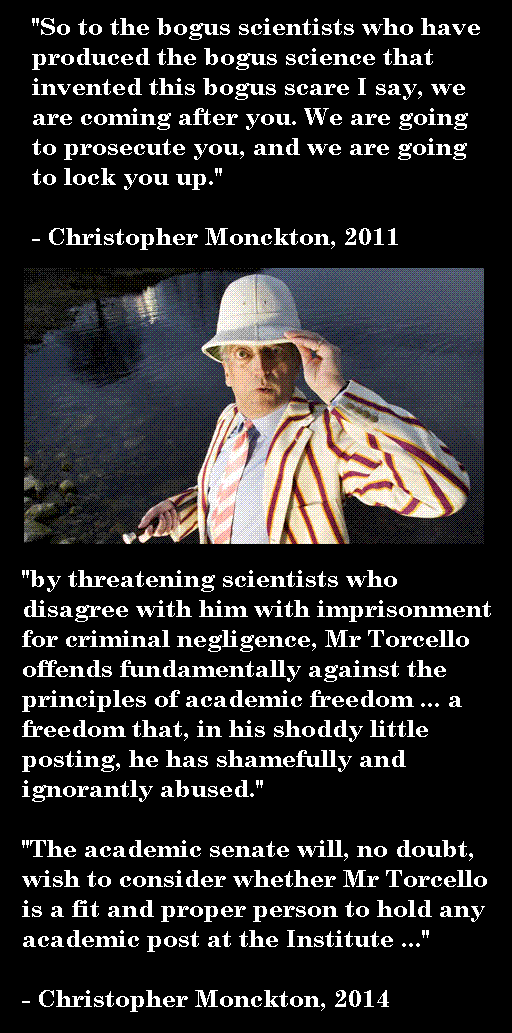
Of course, anything like this is like a red rag to a bull and the biggest purveyor of bull is Lord Christopher Monckton, 3rd wotsit without a seat in the Lords of Brenchley.  You know how it goes.  Write letter of complaint at great and tedious length in words that could be better deployed in a Lawrence Durrell novel and then, well usually nothing.  Old Chris is rather good at the first bit but it all sort of fizzles out after that.  Not for him a second firework.  Oh, no. 

Amusingly, of course, since this is Monckton we're talking about, he chose to ignore Watts's injunction to be "factual".  Courteous, insofar as Monckton is courteous (he has an educated slyness about him) but factual he isn't.  When confronted with the errors in his presentations, be they talks or written, Monckton does not bother about correcting his mistakes.  He merely continues making them.  I can't see a University taking their direction from this dunderhead. 

If you don't believe me, do what real skeptics do.  Check the facts.  Here is a Potholer video that does that checking for you:


Or try Climate Asylum's rap sheet on Monckton.

So I can't expect the Rochester Institute Of Technology where Torcello works will be lectured to on matters of the truth by serial dissembler Christopher Monckton.

It would appear that climate change deniers just don't understand hypocrisy.  Just don't understand the English language very well at all.  Perhaps that is why they are so impressed by Monckton's florid but vapid outbursts.  It is hypocritical that Watts has deleted comments on religion while allowing Monckton to post his Christmas message to his flock in December, or to allow countless comments along the lines of AGW is religion.  If he is doing all this for free then he sells himself too highly.  If Watts has a consistent policy then I'd love to see him outline it.  My comments are free.  I don't delete anything that isn't spam.  I don't even have a comment policy.  Say what you want.

I began thinking about this post when I read Monckton's drivel.  I firmed my decision when I read AndThenThere'sPhysics post entitled Climateball(TM).  It is further evidence of the hollow nature of climate change deniers.  Anders has tried to be as fair and as polite to all sides as possible.  I don't know the blogger but I have detected a growing weariness that, no matter how polite, how fair, how honest and how patient, arguing with a denier is the equivalent of nailing a jelly to a wall.  You end up with a mess, a stain on the wall to remind you, lots of holes and nothing achieved.  The reason is simple.  Deniers don't want to know the truth.  They are not interested in the truth.  They just want you to know that not only are they ignorant, but loudly and persistently ignorant.  After all, they, like me, could just read the truth.  It is out there.

But some people just don't get it.

Update
Someone tweeted this to underline the hypocrisy of some:
Sunday, 23 March 2014

Claim - climate scientists are running scared of debates

I use the word claim in the ironic way that Anthony Watts uses it over at WattsUpWithThat: I don't believe it.

There's a reason I don't believe it.  But first, Watts has posted this (archived) in which he notes that climate scientists are not willing to debate the skeptics and that the BBC is keeping deniers away from scientists.  My, my, what a touchy little group the deniers are.

Some of you might be aware that Bill Nye the Science Guy debated creationist Ken Ham recently and it was generally accepted that Ken Ham became the mop with which Nye swept the floor.  But many believed Nye was wrong to take the challenge, and maintain that science lost and that creationism had the most to gain.  The thing is, as in the now oft quoted maxim, a debate looks good on the denier's CV, not so good on the scientist's.

Why?  It's simply easier to keep chucking out questions in a debate than it is to answer them.  And the scientist has the harder job because the denier only has to sow doubt in the audience's mind, not establish any truth.  That's why we get the Gish Gallop, the stream of accusations, assertions and questions that the scientist neither has the time nor the knowledge to counter. 

It might seem strange that I said knowledge there but it is no accident - the deniers can drag their assertions for doubt from anywhere in science.  The scientist, on the other hand, is there because he is an expert in something, and has less knowledge about much of science than you might think.  Why should they?  Their job is not to know all science but to be masters in their chosen field.  The denier, on the other hand, doesn't need to know anything at all about science.  They need only be able to identify a tricky question, hide it in a pile of other, breathlessly spoken sentences and then return to it when the scientist has omitted to answer it.  It is a simple rhetorical device and one hollow of the intention to uncover the truth.

Debates are a game.  Some are very good at them, but scientists are not trained in them (I bet Lord Monckton was part of the debating society at school and then at Cambridge) and don't need to take part in them.  Science is not won or lost by a rhetorical flourish or two.  It is won or lost on hard earned evidence. 

So scientists don't often debate in the formal setting that the climate deniers would love to get them in. 

And news programmes are not the vehicle for debates either.  Science is not about opinion and there really aren't two opposing sides in spite of what climate deniers would have us believe.  Or creationists or antivaxxers or ....  You get the picture.

I've heard plenty of opposing views being expressed in close proximity on the news over the years.  It is entertaining but hardly enlightening.  The BBC recognised some time ago that there was a spurious desire for balance in scientific stories where none was justified.  I am glad to say they ignored anyone wanting to claim a religious reason behind the BICEPS2 results, that inflation did occur in the extremely early Universe.  That would have been stupid.  The story was about a scientific discovery.  Climate change stories are equally about the science in the main.  If they are about the policy then there is some room for balance.

There is another challenge in the balance problem the BBC has.  A climate scientist with expertise and understanding in climate science, could find themselves up against a chemistry graduate turned accountant, for instance.  It puts the climate scientist who has spent years studying and refining their ideas on a spurious level with someone who really does their climate science as a hobby.  A good many bloggers, and I include myself amongst this group, do what they do as a hobby.  If the mighty on the Internet want to know what I think, they can read it here.  If not, well, it's their right.

I don't expect the BBC to ring me up to ask me what I think on some topic.  In fact, I've decided to have fewer opinions.  It doesn't really matter what I think about One Direction or celebrity X's marital problems.  But I reserve the right to spout off when I feel there is something I can add.  Hence this post.

If I wanted someone to debate a climate denier, I wouldn't go for a climate scientist per se but someone like Sam Harris.  He is a scientist, a neuroscientist, and he is sharp as a pin.  In some areas he is controversial, but he is the sort of person who can carry a debate because he understands that debates are not about the truth but about scoring points.


And that video has some very good point scoring.

For a long time now the pseudodebate desired by deniers in all those scientific areas that denial touches has been about raising doubt.  The truth is that ugly juggernaut.  It won't be stopped, just delayed.  A debate, in a theatre or TV studio, won't change the reality.  Monckton or one of his mates can win all the debates on climate change that they care to stage.  Truth isn't established there.  Or on this or any other blog.  When the deniers understand this, perhaps they will shut up asking for debates.  I doubt it.

Sunday, 16 March 2014

Now I'm confused - the incredibly useless denier scale

Apparently unfunny cartoonist Josh (aka Tosh in my house) reckons this (I'm using it to illustrate my point) makes understanding the climate controversy easier.
But it doesn't.

Activism is not at the far left end of the scale at the top.  Otherwise most of the bunch in the middle would be in that category.

And mitigation and adaptation are policies while policy on its own is meaningless. And adaptation doesn't necessarily mean spending less.  It probably means spending more, just that our grandchildren pick up the tab.

More rubbish, I'm afraid, from WUWT which is just what you'd expect.

So let's be honest and call it propaganda.

Updated to correct some spellings and change slight wording in the second set of brackets in the first sentence. 

Thursday, 6 March 2014

Deniers have history

Like a broken record, climate change deniers love to get antsy about being called deniers.  There have been lengthy discussions about the use of the word because it has an inevitable association with Holocaust deniers, a usage which became prominent in the 1980s.  Climate change deniers get angry because they see themselves as being lumped into the same category of evil genocidal master race promoters. 

Perhaps they should look a bit deeper (what am I saying?).
from http://lab-initio.com/sci_archaeology.html (I'll remove if copyright holder contacts me and asks me to but it was too good a cartoon to ignore)

Since the average climate change denier doesn't want to dig, I thought I would.  It didn't take long and it surely wasn't beyond the wit of Anthony Watts or Roy Spencer  to have done some detective work but, no, the message is more important if it is shocking rather than true. 

The strength of the denial of the word denier relies on the association.  It falls, therefore, on the reason why Holocaust denier means someone who disavows the Holocaust in the same way that someone who is labelled a climate change denier is someone who disavows climate change.  And if the word denier predates the Holocaust then the argument that the word denier is anathema is weakened further.

I think you know where this is going.

Point your browser here.  Search denier.

Here is Baden Henry Baden-Powell in his evolution denying volume, Creation And Its Records:
The denier of creation replies, that just in the same way as, by the laws of affinity, other inanimate substances came together to produce the earth—salts and other compounds we see in the world around us—so did certain elements combine to form protoplasm. This combination when perfected has the property of being alive, just as water has the property of assuming a solid form or has any other of the qualities which we speak of as its properties.
The "denier of creation" is using the word denier in exactly the same way as we use it now to describe someone who disavows something.  B H Baden-Powell, half brother of the founder of the scout movement and probably a hero of Christopher Monckton (have you read The Heretics by Will Storr?), died in 1901.  Whoops.  That's at least 113 years of the word denier in the meaning it has now. 

If you're not convinced, Project Gutenberg has the complete text.

There's more.
Among other vices ascribed to democracy, we are told that it is against science, and that "even in our day vaccination is in the utmost danger" (p. 98). The instance is for various reasons not a happy one. It is not even precisely stated. I have never understood that vaccination is in much danger. Compulsory vaccination is perhaps in danger. But compulsion, as a matter of fact, was strengthened as the franchise went lower. It is a comparative novelty in English legislation (1853), and as a piece of effectively enforced administration it is more novel still (1871). I admit, however, that it is not endured in the United States; and only two or three years ago it was rejected by an overwhelming majority on an appeal to the popular vote in the Swiss Confederation. Obligatory vaccination may therefore one day disappear from our statute book, if democracy has anything to do with it. But then the obligation to practise a medical rite may be inexpedient, in spite of the virtues of the rite itself. That is not all. Sir Henry Maine will admit that Mr. Herbert Spencer is not against science, and he expresses in the present volume his admiration for Mr. Spencer's work on Man and the State. Mr. Spencer is the resolute opponent of compulsory vaccination, and a resolute denier, moreover, of the pretension that the evidence for the advantages of vaccination takes such account of the ulterior effects in the system as to amount to a scientific demonstration. Therefore, if science demands compulsory vaccination, democracy in rejecting the demand, and even if it went further, is at least kept in countenance by some of those who are of the very household of science. The illustration is hardly impressive enough for the proposition that it supports.
This is from Studies In Literature by John Morley, published in 1891 (this book is actually a collection of earlier pieces, this one from 1886).  I quote the whole paragraph but pick out the offending word in bold because the whole paragraph illuminates what is now clearly a well established idea: deniers have history and the word has been used to describe them for more than a century.  Monckton wouldn't like Morley: he was a Liberal.
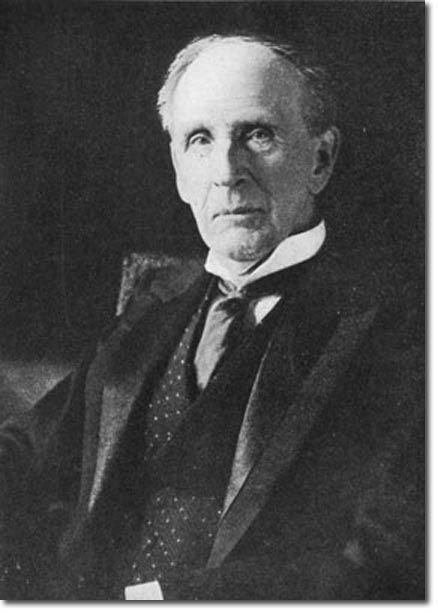
Viscount Morley of Blackburn

I think I've made my point.  The word denier in the sense used for climate change deniers is a word with a lengthy history, more than a century, and from the hands of reliably Empire building British establishment men of the kind that Christopher Monkcton would approve.  So forget the Holocaust in this matter at least (remember it and its human victims), the word denier is wholly appropriate and wholly acceptable.  After all, it was used at least 128 years ago, and by a Viscount to boot.

Thursday, 20 February 2014

Dr Roy Spencer - language denier

I think the best word to sum up those that deny climate change should be comedian (or comic if you are across the pond).  And as exhibit A I propose real scientist Dr Roy Spencer.  His latest pronouncement to the world shows he's just a tad grumpy (archived).

You see, Roy doesn't like the word "denier" which he reckons is forever linked with the idea of Holocaust denial which is beyond the pale.  Well, Roy, here's some news for you.  Language changes, words alter meanings or get associated with different ideas all the time. 
Focus on the hair
For example: I think Dr Spencer has a gay haircut.  I suspect he would get very, very grumpy about that.  It wouldn't do, not in Alabama so far as I know.  Anyway, "gay" in the sense I use it here has the meaning of "full of light-heartedness and merriment".  It is a long established meaning, but one that is less commonly used as we now use gay to mean homosexual.  That's fair enough.  Language contains fossils just like the rock strata do.  But Dr Spencer might not be aware of that.

Denier also has a history.  It is a small medieval coin, a measure of the weave of fibres, a person who contradicts established ideas, a small trifling sum.  So perhaps that last definition is the sense in which we should use the word in the context of those that deny climate change in one or more of its forms. 

I think the point is made.  Read Spencer's rambling (meaning = jewellery for sheep) and you will find some political rant rather.  Perhaps he should get out more.

A Richard Feynman Primer For Deniers

Deniers love Richard Feynman.  He was everything that they could hope for, successful, witty, a hit with the ladies, a bona fide genius and Nobel laureate.  They love to quote him because he seems to support what they are aiming at: science is uncertain, some bits of science aren't true, etc.

But I sometimes wonder what Feynman would have made of the denialists.  Since he died in 1988 it isn't possible to ask him and I don't have to hand his collected works so I can't interrogate them either.  But he left some interesting quotes, the sort that the deniers usually don't bother with, that give us an idea of what he might have thought, for instance, of climate change denial.

First exhibit:
“Ordinary fools are all right; you can talk to them, and try to help them out. But pompous fools-guys who are fools and are covering it all over and impressing people as to how wonderful they are with all this hocus pocus-THAT, I CANNOT STAND! An ordinary fool isn't a faker; an honest fool is all right. But a dishonest fool is terrible!”
I can think of some examples of the dishonest fools that Feynman might mean here.  In the interests of keeping lawyers unemployed, I shall not name names but leave it to the reader to guess who I might have in mind.  Some of them are peerless, others not so.

Second exhibit:
"So my antagonist said, "Is it impossible that there are flying saucers? Can you prove that it's impossible?" "No", I said, "I can't prove it's impossible. It's just very unlikely". At that he said, "You are very unscientific. If you can't prove it impossible then how can you say that it's unlikely?" But that is the way that is scientific. It is scientific only to say what is more likely and what less likely, and not to be proving all the time the possible and impossible.”
 Climate was less of an important topic when Feynman was alive but UFOs were.  The point of this quote is clear - Feynman was a true skeptic.  The fake skeptic denialists are certain they have shown anthropogenic climate change is impossible.  The proponents of AGW have demonstrated the idea beyond reasonable and scientific doubt. 

Third exhibit:
“A philosopher once said, "It is necessary for the very existence of science that the same conditions always produce the same results." Well, they don't!” 
Deniers put unreasonable demands on scientific evidence.  Just like Feynman's hypothetical philosopher.

Fourth exhibit:
“Of course, I am interested, but I would not dare to talk about them. In talking about the impact of ideas in one field on ideas in another field, one is always apt to make a fool of oneself. In these days of specialization there are too few people who have such a deep understanding of two departments of our knowledge that they do not make fools of themselves in one or the other.” 
In other words, unless you are truly expert, don't act as if you were.

My opinion is that Feynman would have laughed the deniers out of court. He would have educated himself first, read some key literature and found out what was true, what was known and what uncertainties there were.  But he would have come down on the side of science against anti-science. He understood as well as anyone that science does find things out that are true and that plenty of science is settled.  He wasn't stupid, like the ordinary fools he met on many of his working days.
 

Sunday, 16 February 2014

On conspiracies

This is a bit of a follow on from the previous post on scientific fraud. It has been inspired by the denier claim that global warming is some sort of conspiracy. I guess it takes two brain cells to see through this one.

But first a disclaimer. Conspiracies do happen. We know about them because someone can't keep a secret, spills some beans and the constabulary gets involved. But the best conspiracies involve just one person.

Problem with conspiracies that involve something rather public, like the moon landings or climate change (other than the fact that such conspiracies don't exist), is that they have to involve not only large numbers of people but also something of a show. That Saturn V rocket wasn't a cardboard cut out. You could, and hundreds of thousands did, got to watch the Apollo launches.

I understand, from years of watching Colombo that criminals need motive, opportunity and means. Excuse me for missing something that the denier seem to think is obvious but, of you are trying to launch a global conspiracy to rid the world of nasty fossil fuel emissions, would you do it this way?

Would you put your data out on the internet so anyone can put it into an Excel spreadsheet and draw pretty graphs? It is a bit hard to hide any nefarious fiddling you might have done with the data if anyone can download it and muck about with it, trying to fit a curve, trying to find an oscillation or two.

Would you put your conspiracy into the peer reviewed science journals, conferences and the like where others, who might not be in on the conspiracy, can ask irritating questions, challenge your conclusions and so on? In thought you wouldn't. If you want to influence governments, lobby them and not worry about published research. And you would make a mistake because you have to keep track of all the lies you have been telling. You would be inconsistent.

Would you design a conspiracy that meant you wouldn't really know how bad it was for decades, probably long after you are dead? One that doesn't really bring much reward for you as a scientist because there are no Nobels for you and just your salary and your pension to look forward to.  And would you stick awkward bits into the data, like a slow down in the rise of surface temperatures which it would be good to explain. And why bother to explain it because that draws attention to it?

It's a rubbish conspiracy, climate change. Or it would be because some young sap would get lots of glory out of proving it all wrong. Humans are like that. There's always one, one who will go against the grain.

Those that try swimming against the climate science tide lack one thing. They miss the whole picture because they are concentrating on the conspiracy, they forget that science, all science, works within the constraints of what is known and what is possible. If the earth does not lose to space as much energy as it gains in radiation from the Sun then it must perforce warm up. There's no conspiracy there. Just physics.

I haven't said anything original here but I can't remember where all these ideas came from. Don't be shy if I should have credited you or some source you know. I will credit you later.