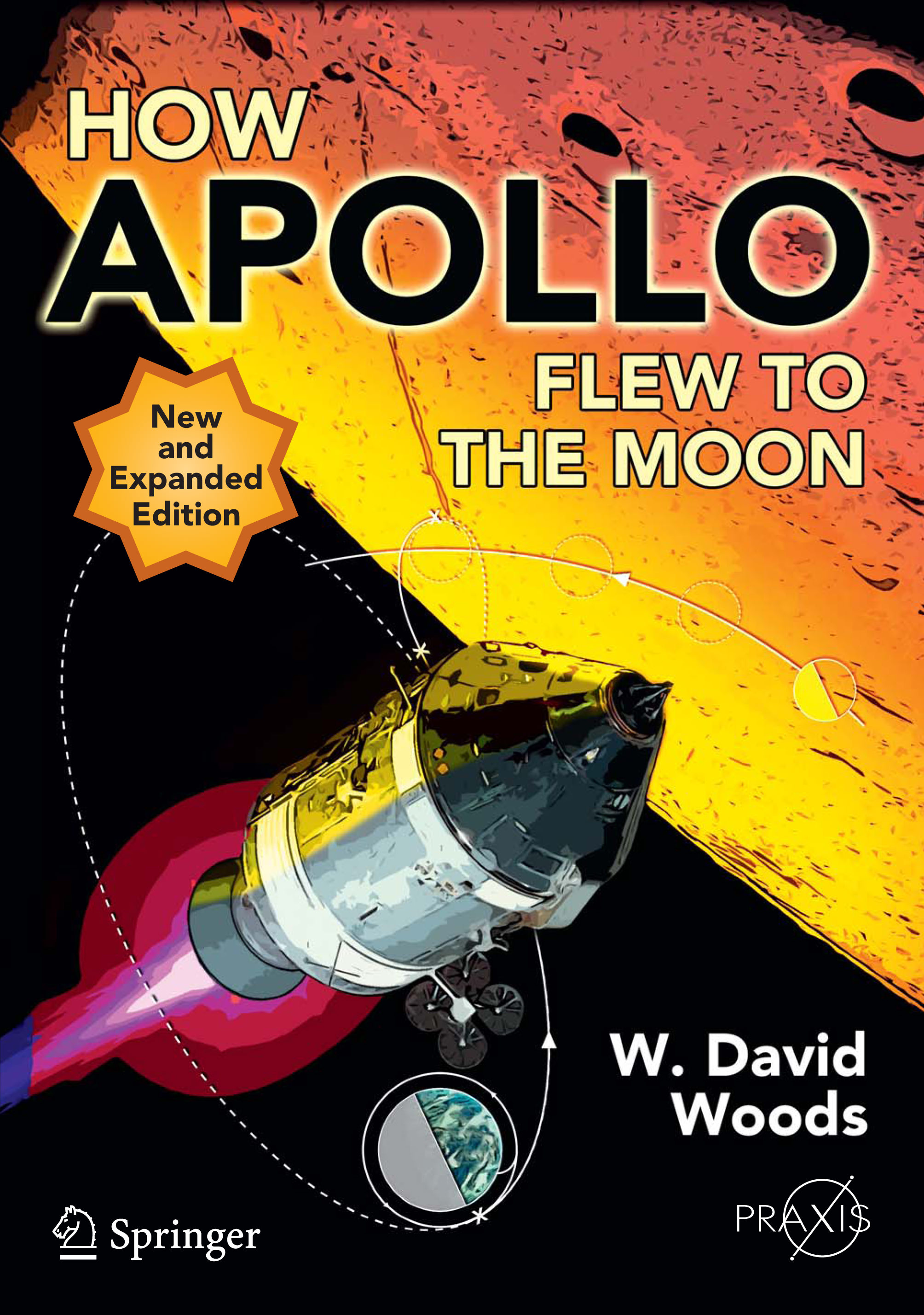
I'm currently reading in what little spare time I have, the second edition of David Woods' book How Apollo Flew To The Moon (Springer Praxis). I read the first edition a few years back when it came out and although I have taken a few months to get hold of this edition, it was worth it. The additions fill out the story that the first edition didn't have space for. But most of all, it is even better than the best book on Apollo I've ever read. And that was the first edition.
The landing of Apollo 15, my favourite Apollo of all time
I thought I knew a lot about Apollo (though I know I am a bit behind a good many space fans out there), but I am learning so much from this book that is totally new to me. Putting on the spacesuit in the confines of the lunar module was, I now know, like a choreographed Jane Austen style dance. I have a good idea of where all the valves were in the spacecraft and what they did. And I reckon I would have loved flying to the moon myself. As an eight year old, that was what I wanted to do.
Playing in the veg patch, kicking up the dust, wearing the American football helmet that Mr and Mrs Nussman had got for my brother. Well, they came close to being on the moon but there was something that wasn't missing. There was too much gravity. I couldn't walk like the astronauts, even if I could do a lot of the noises.
The boat has been well and truly missed. But I have got to meet a few who walked on the surface of another celestial body: Aldrin, Bean, Cernan, Scott. And they are all wonderful gentlemen. My current bedtime reading matter is a truly worthy tribute to those who ventured the quarter of a million miles in a tin cone of oxygen and clambered into a spiny lander to meet the lunar dust.
If you do want to kow more, here is David Woods' site
Marcel Proust, who famously (according to Monty Python, had a haddock, is remembered mostly for an enourmously long book that few have read and for a tiny part of that book referring to a cake:
"No sooner had the warm liquid mixed with the crumbs touched my palate
than a shudder ran through me and I stopped, intent upon the
extraordinary thing that was happening to me. An exquisite pleasure had
invaded my senses, something isolated, detached, with no suggestion of
its origin. And at once the vicissitudes of life had become indifferent
to me, its disasters innocuous, its brevity illusory – this new
sensation having had on me the effect which love has of filling me with a
precious essence; or rather this essence was not in me it was me. ...
Whence did it come? What did it mean? How could I seize and apprehend
it? ... And suddenly the memory revealed itself. The taste was that of
the little piece of madeleine which on Sunday mornings at Combray
(because on those mornings I did not go out before mass), when I went to
say good morning to her in her bedroom, my aunt Léonie used to give me,
dipping it first in her own cup of tea or tisane. The sight of the
little madeleine had recalled nothing to my mind before I tasted it. And
all from my cup of tea."
For me, my madeleine moment comes each summer as I sit to mark exam papers. There is no need to break a confidence here, so my bosses at a major exam board need not have apoplexy, because it is not the students' responses that matter but the question papers themselves. Upon seeing them I am transported back to a hot and airless room where I am sitting trying to delve deeply into the recesses of my memory for facts about chemical equilibria and electron spins, aldehydes and ketones and, well, anything that had been drilled into me by my chemistry teachers for two years. For some unknown reason it is the chemistry exam that I recall, and in exquisite detail.
I can remember the desks, giant wooden ones with a slight slope and holes for ink wells at the top right hand corner. They are varnished and a honey glaze colour. There is a board at the front, for chalk, with the start and finish times on it. Because it is a lengthy paper, the finish time is after normal school finish time and the rush for the bus home.
I can remember the light on my right but although it is a sunny day, the northern aspect means I don't get it directly. Just as well as it is warm enough already. And I remember the fact that my girlfriend of the time will be waiting in the corridor outside for me when I finish. We shall be going to her house straight after.
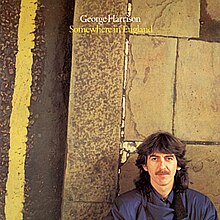
The memories of the exam room (it was the only time I sat a paper in this, a maths room normally so perhaps that is what makes it stand out) widen into the broader brush strokes of that exam season. There is the music: George Harrison's Somewhere In England, the Floyd's The Dark Side Of The Moon (which I initially found dull), Simon & Garfunkel, Beach Boys, The Byrds and The Beatles. There is sitting in the local park between papers one day. And going to see tennis at Queen's Club with John McEnroe throwing a tantrum, because he was bored (as was I - it was one sided game). Oh, and England were doing not so well in what became Botham's Ashes.
The George album is one of my favourites, even today. I love it not just for the music but the memories it evokes too. That summer was a glorious time: Charles and Di's Wedding, the end of school and the promise of university, the Ashes, discovering all sorts of new music (and heading distinctly the opposite way to my brother's soul fixation).
The thing is, why does my memory, and everyone else's I believe, play this trick and bring forth a vivid memory from a tiny stimulus. I think the answer is a simple nobody knows. Partly, I think, because no one really has got to the bottom of how memories are stored, whether chemically, in DNA or RNA or as circuits of neurons. The teleological answer to the why question is almost certainly because a similar situation can require a similar response, and the stronger the original emotional investment, so to speak, the more likely it is to get a deeper and more detailed memory.
So my biology papers never evoke this response because I was better at those and the chemistry was the one I really wanted to get right. But memory has a habit of being so elastic that it can get stretched out of shape. Did I really go through those things I described?
In this case, the answer is pretty much a yes. But one memory I have and which differs markedly from my dad's recollection of the event is the first moonwalk. I saw bits of it on later rebroadcasts during the day of 21 July 1969. My dad is adamant that I was awake for it, even though I know I wasn't. I went to bed after the lunar module landed and have no recollection of anything until I awoke the next morning at normal time. I was brought down to watch but I was so tired it made no difference.
So in true memorial fashion, perhaps we should have a where are they now item to finish up.
I suspect my chemistry teachers are well retired, possibly still with us. The old girlfriend left me for a marine (honest) eighteen months later. George Harrison died in 2001 and my dad is still with us. Unlike Ian Botham, my dad never got a knighthood.
We are led to believe that before Galileo no one believed that the cosmos, the realms beyond planet Earth, could change and that all celestial bodies were perfect and incorruptible. History books also tell us that everyone thought the Earth was flat until that pesky Columbus said, No, 'tis round and luckily I know a short cut to the Indies.
What Galileo did was point his telescope at things of interest up in the sky, the Moon, Jupiter, Venus and so on, and demonstrate to anyone with at least one working eye and a modicum of open mindedness, that things in the heavens weren't always quite the same as they were the day before yesterday. And the single most corruptible of those heavenly bodies turns out to be the Sun.
One of Galileo's sunspot sketches
Before Galileo there were reports of sunspots. But you can't just look at the Sun and see them, so those reports are very rare. Only at sunrise and sunset do the intensely bright and damagingly hot rays of the Sun become ameliorated enough to be able to bear them for more than a split second. Then you can see the odd blemish on the surface of the Sun with your unaided eyes. Galileo wisely did not peer down his telescope (HEALTH AND SAFETY GONE SENSIBLE: DO NOT EVER EVER EVER LOOK AT THE SUN THROUGH A TELESCOPE, BINOCULARS OR ANYTHING ELSE WITH YOUR OWN EYES (UNLESS YOU HAVE A PROPER SOLAR FILTER OVER ALL THE LENSES AT THE OTHER END OF YOUR DEVICE) projected an image and then drew what he saw.
I used the same method myself yesterday. I have a small, 3 inch reflector that's very handy for deep sky objects but also works nicely for projecting the late afternoon Sun onto the ceiling of my porch. I did it to show my granddaughter something she won't see too often - a naked eye sunspot. This one is called AR1476 and it is very big indeed, and active and could interfere with communications and electricity grids down here on the good Earth. The NASA image left shows how large, in comparison to the size of the Sun, this sunspot is. It was clearly visible on my porch ceiling and the grandaughter left having seen it going "Sun, mummy, spot."
My limited technology does not extend, sadly for the moment, to solar filters and the like so I was deprived of having an even closer view. As might have been guessed, sunspots have structure so large magnification reveals the spot to be a roiling mass of fingers of superhot gas, trained by the rippling magnetic fields of the Sun's inner structure poking through into the visible sphere. So this photo from David Maidment in Oman (via spaceweather.com) captures even more wonderment and delight than the NASA picture:
If you have a small telescope or a pair of binoculars, take the occasional safe look at the Sun. It is not just a yellow circle up there to warm and tan you. It is a fascinating object in its own right.
If I were asked for the identity of my favourite organism, I might be tempted to say slime moulds. So, hands up all those who have heard of slime moulds. Hmm. Thought there might not be too many hands.
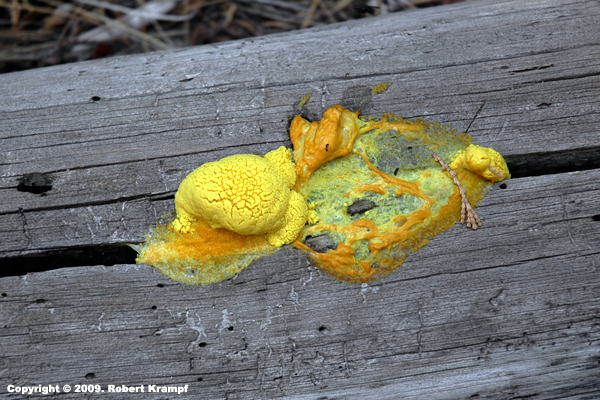
There's a reason for that. Slime moulds just aren't famous. They don't have any PR, unlike the tasty or toxic mushrooms, the annoying pin moulds and the ubiquitous yeast. But then slime moulds aren't moulds at all, because they aren't fungi. They are protists, single celled organisms, and can grwo very big for microbes. Some slime moulds occupy an area of several square metres and have a mass of up to 30g. Look for them on fallen logs where they chomp on the bacteria that are part of the decay process and look like brightly coloured slime patches.
The reason I love slime moulds is because they are just so odd. Most people now no longer encounter nature so readily as they used to. My family, for instance, had never seen a weasel until we saw one while visiting my mother's grave one day last year. For city dwellers, wildlife is often birds and foxes and little besides. That's a shame but I was brought up to turn over logs and stones to see what was beneath, and I spent a summer investigating the ponds and streams around my village, mostly in search of my second favourite life form, the planarian flat worm. But slime moulds are odd.
From daviddarlinginfo
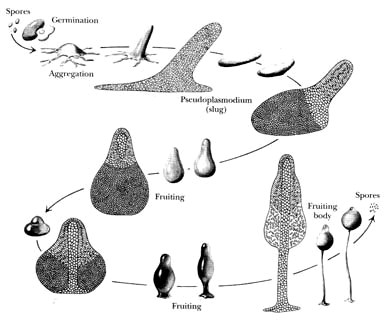
Some of them consist of a single cell with hundreds of nuclei. Sometimes they group together to form a slug-like entity that moves away and forms a fruiting body that releases spores. So there is an element of multicellular life in there and the evolutionary importance of such behaviour has not been lost. Not that we have entirely worked out the evolution of these things.
I first came across slime moulds when I met the UK's chief scientist of the time, John Ashworth, through his eldest daughter. She loaned me his slim book on slime moulds, The Biology Of Slime Moulds in the good old studies in biology series that Unwin published in the sixties and seventies. I read the book as a sixteen year old then bought my own copy when I visited Nottingham University a couple of years later. I have since lost the book sadly. It's not much of a read but it's not meant to be. It is an overview of what was known about these strange creatures at the time. I could get it for a penny at Amazon if I wanted.
Perhaps the most interesting thing about slime moulds is that they can solve puzzles like mazes in a most efficient way. All in all they should have better PR.
Anyway, look under or on logs in the future to see if you can find some slimy looking patches. They might be slime moulds.
A sad moment, last week, when Levon Helm, the heart and soul of The Band, passed. A truly great voice of American music is gone. I don't think I've been so sad at someone's death in a long time, outside of those people I knew personally that is.
It is a strange thing, mourning a celebrity. There's a scene in the John Lennon film Imagine where a delusional young turns up at Lennon's mansion. John is kind hearted but blunt enough to point out that the songs aren't about the young man. If anything, they're about John and Yoko. I never felt for one minute Levon and The Band were singing about me. They just seemed to be having so much fun.
The Band were five master musicians, three superb singers, one great songwriter and a fantastic bunch of men. When the world was going day-glo crazy, they decided that a monochrome world was much more interesting. No Sgt Pepper for them. Instead, they turned on a whole bunch of more famous muicians, Clapton, Elton, George Harrison amongst others, to the possibility that songs could be quiet, played with wooden instruments and rely on the soul of the musicians to make them special. They did just that.
I came to The Band in the way that many others must have done over the years, through the music of Bob Dylan. The Band, while known as the Hawks, back Dylan in 1965-6 on the tours that are famous for the booing and the Judas shout. Levon backed away from that so he's not on the famous 1966 bootlegs. He didn't come back until 1967 after Dylan had fallen off his Triumph and cracked his neck and his campadres were doing quiet but soulful things in a basement with a four track tape machine.
In 1968, The Band emerged in their own write with Music from Big Pink, an album so out of synch with the times that it could have been from another planet. But it is also chock full of classics, "The Weight", "I Shall Be Released", "This Wheel's On Fire", "Tears Of Rage" and so on. If you're going to buy one Band album, then this should be your second purchase.
That's because the follow up, the brown eponymous album, is even better. I won't list the tracks to look out for. Just buy it. It's a classic and better than anything you'll find on the album charts this week by a huge distance. Those three singers, rather than fill up the song Mariah Carey style, know when to sing and when to leave alone. That's my mark of a great singer.
And Levon was a great singer. A rich southern accent gave him a distinct singing voice. Better than that, he was the pivot of the Band. Not quite as steeped in alcohol and partying as Richard Manuel or Rick Danko, or as studious as Robbie Robertson and Garth Hudson. Without Levon The Band might not have been worth listening to. He gave the group a soul that the others could swing around. And he did most of it from the drummer's stool. There are few drummers who sing, let alone do both at the same time so well as Levon did. And that loose drumming is distinctive and all his own. Levon, like Ringo, played the song, not the drums.
After the second album, The Band fared less well and it is convenient consensus that says they never regained the heights but there is a bootleg of a concert a few weeks before their break up Last Waltz gig that is required listening. Luckily they were taped for a radio station and the results were superb. I won't tell you how to get it but if you do, you'll know why it is recommended. But in those six years The Band did not let their true selves become lost. The music was still as true as ever, with highlights on lesser albums that most groups would give arms and legs to have: "It Makes No Difference", "Stagefright", "Arcadian Driftwood" and so on. When they split, it was in style, and with Martin Scorsese's cameras in attendance. Buy the movie.
Like I said, I came across The Band when listening to Bob Dylan. That was 1982. The first album I bought was a best of. It took me three years to get down to listening to them properly and now I wouldn't be without them. I stayed up half the night to watch The Last Waltz on BBC2. I even got the reunion albums in the 1990s. I didn't appreciate The Band until I was grown up. And that in the end may be the greatest compliment to them. They made grown up music in a world of screaming teeny boppers. When The Beatles grew up and grew apart, they did so as a clone of The Band.
Let's be honest. Who wouldn't have wanted to see a Saturn V launch? A million people turned up to see Apollo 11 launch and I'm sure they didn't waste their time. When they lit those F1 engines at the business end of the first stage and they reached 7.7 million pounds of thrust, the ground shook. I wish I'd been there.
I nearly was. Well, I tried to be there the only way I knew how. I entered the Look-In magazine competition. Look-In was for young teens and revolved around pop music and ITV programmes. It was entertaining in its way and I took it for a number of years but the important thing about the Apollo 16 competition is that I didn't win.
So my first look at a Saturn V in the flesh was when I saw those F1s above at the Kennedy Space Center the first time I visited in 2003. It doesn't matter how many times I've been back - those F1s get me every time. How on Earth did they balance a 363 foot tower upright, then get it to get off the ground? Stunning.
For those of us who have an urgent need to see Saturn Vs on a daily basis and who don't work at the Kennedy Space Center (I'd love to), then we can make do with the work of Mark Grey and Spacecraft Films. He sensisbly realised that there was a market for those of us who want the physical throb of that behemoth lifting from Pad 39A (and once from 39B) by putting together three DVDs of archive footage of all the Saturn V launches (that's Apollos 4, 6, 8, 9, 10, 11, 12, 13, 14, 15, 16, 17 and Skylab 1), in the minutest detail, with all those glorious engineering cameras mounted in all those nooks and crannies on the launch umbilical tower.... Wonderful. I've linked to the right to Spacecraft Films so if I have whetted your appetite, then go there. The Saturn V set is a snip and well worth having.
And if that is not enough, take a look at this video.
I stopped believing in Father Christmas when he failed to bring me the one thing I most wanted in all the world: the 1/144th scale Airfix Saturn V. No matter that I got it for my birthday a couple of months later. The damage was done.
That was about 1971-2. I can't be sure. In 1994 I made the model again, this time with the benefit of paints and patience, and the fact I wasn't making a model that I would play with. So I made it better, though not as well as some of the wonderful modellers could have made. Try this site for some brilliant examples of spacecraft models.
Anyway, I've gone and bought the Saturn V model again, though this time I have bought the recently introduced Airfix Skylab variant. It has the bits in it to mak the normal version, more or less, but I've only just begun and these days, with the eyes being a little less keen on small parts, it will take more patience and a set of new paint tins. You see, having been to see the real thing in Florida (several times), I now want accuracy.
I shall be looking over my holiday photos to check on the colours. I took a pile of reference photos a couple of years back. I'll keep you posted.