If I were asked for the identity of my favourite organism, I might be tempted to say slime moulds. So, hands up all those who have heard of slime moulds. Hmm. Thought there might not be too many hands.
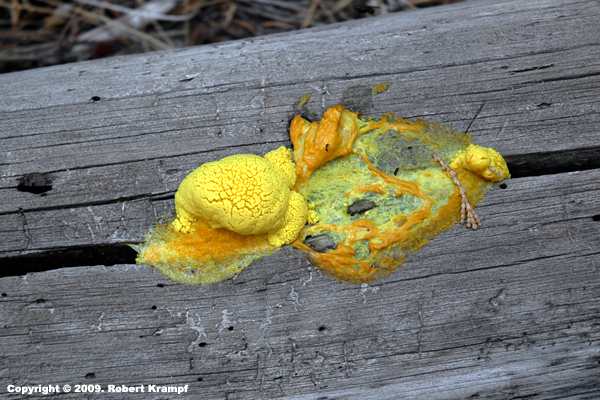
There's a reason for that. Slime moulds just aren't famous. They don't have any PR, unlike the tasty or toxic mushrooms, the annoying pin moulds and the ubiquitous yeast. But then slime moulds aren't moulds at all, because they aren't fungi. They are protists, single celled organisms, and can grwo very big for microbes. Some slime moulds occupy an area of several square metres and have a mass of up to 30g. Look for them on fallen logs where they chomp on the bacteria that are part of the decay process and look like brightly coloured slime patches.
The reason I love slime moulds is because they are just so odd. Most people now no longer encounter nature so readily as they used to. My family, for instance, had never seen a weasel until we saw one while visiting my mother's grave one day last year. For city dwellers, wildlife is often birds and foxes and little besides. That's a shame but I was brought up to turn over logs and stones to see what was beneath, and I spent a summer investigating the ponds and streams around my village, mostly in search of my second favourite life form, the planarian flat worm. But slime moulds are odd.
From daviddarlinginfo
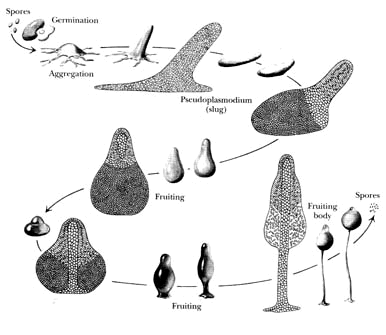
Some of them consist of a single cell with hundreds of nuclei. Sometimes they group together to form a slug-like entity that moves away and forms a fruiting body that releases spores. So there is an element of multicellular life in there and the evolutionary importance of such behaviour has not been lost. Not that we have entirely worked out the evolution of these things.
I first came across slime moulds when I met the UK's chief scientist of the time, John Ashworth, through his eldest daughter. She loaned me his slim book on slime moulds, The Biology Of Slime Moulds in the good old studies in biology series that Unwin published in the sixties and seventies. I read the book as a sixteen year old then bought my own copy when I visited Nottingham University a couple of years later. I have since lost the book sadly. It's not much of a read but it's not meant to be. It is an overview of what was known about these strange creatures at the time. I could get it for a penny at Amazon if I wanted.
Perhaps the most interesting thing about slime moulds is that they can solve puzzles like mazes in a most efficient way. All in all they should have better PR.
Anyway, look under or on logs in the future to see if you can find some slimy looking patches. They might be slime moulds.
A sad moment, last week, when Levon Helm, the heart and soul of The Band, passed. A truly great voice of American music is gone. I don't think I've been so sad at someone's death in a long time, outside of those people I knew personally that is.
It is a strange thing, mourning a celebrity. There's a scene in the John Lennon film Imagine where a delusional young turns up at Lennon's mansion. John is kind hearted but blunt enough to point out that the songs aren't about the young man. If anything, they're about John and Yoko. I never felt for one minute Levon and The Band were singing about me. They just seemed to be having so much fun.
The Band were five master musicians, three superb singers, one great songwriter and a fantastic bunch of men. When the world was going day-glo crazy, they decided that a monochrome world was much more interesting. No Sgt Pepper for them. Instead, they turned on a whole bunch of more famous muicians, Clapton, Elton, George Harrison amongst others, to the possibility that songs could be quiet, played with wooden instruments and rely on the soul of the musicians to make them special. They did just that.
I came to The Band in the way that many others must have done over the years, through the music of Bob Dylan. The Band, while known as the Hawks, back Dylan in 1965-6 on the tours that are famous for the booing and the Judas shout. Levon backed away from that so he's not on the famous 1966 bootlegs. He didn't come back until 1967 after Dylan had fallen off his Triumph and cracked his neck and his campadres were doing quiet but soulful things in a basement with a four track tape machine.
In 1968, The Band emerged in their own write with Music from Big Pink, an album so out of synch with the times that it could have been from another planet. But it is also chock full of classics, "The Weight", "I Shall Be Released", "This Wheel's On Fire", "Tears Of Rage" and so on. If you're going to buy one Band album, then this should be your second purchase.
That's because the follow up, the brown eponymous album, is even better. I won't list the tracks to look out for. Just buy it. It's a classic and better than anything you'll find on the album charts this week by a huge distance. Those three singers, rather than fill up the song Mariah Carey style, know when to sing and when to leave alone. That's my mark of a great singer.
And Levon was a great singer. A rich southern accent gave him a distinct singing voice. Better than that, he was the pivot of the Band. Not quite as steeped in alcohol and partying as Richard Manuel or Rick Danko, or as studious as Robbie Robertson and Garth Hudson. Without Levon The Band might not have been worth listening to. He gave the group a soul that the others could swing around. And he did most of it from the drummer's stool. There are few drummers who sing, let alone do both at the same time so well as Levon did. And that loose drumming is distinctive and all his own. Levon, like Ringo, played the song, not the drums.
After the second album, The Band fared less well and it is convenient consensus that says they never regained the heights but there is a bootleg of a concert a few weeks before their break up Last Waltz gig that is required listening. Luckily they were taped for a radio station and the results were superb. I won't tell you how to get it but if you do, you'll know why it is recommended. But in those six years The Band did not let their true selves become lost. The music was still as true as ever, with highlights on lesser albums that most groups would give arms and legs to have: "It Makes No Difference", "Stagefright", "Arcadian Driftwood" and so on. When they split, it was in style, and with Martin Scorsese's cameras in attendance. Buy the movie.
Like I said, I came across The Band when listening to Bob Dylan. That was 1982. The first album I bought was a best of. It took me three years to get down to listening to them properly and now I wouldn't be without them. I stayed up half the night to watch The Last Waltz on BBC2. I even got the reunion albums in the 1990s. I didn't appreciate The Band until I was grown up. And that in the end may be the greatest compliment to them. They made grown up music in a world of screaming teeny boppers. When The Beatles grew up and grew apart, they did so as a clone of The Band.
Let's be honest. Who wouldn't have wanted to see a Saturn V launch? A million people turned up to see Apollo 11 launch and I'm sure they didn't waste their time. When they lit those F1 engines at the business end of the first stage and they reached 7.7 million pounds of thrust, the ground shook. I wish I'd been there.
I nearly was. Well, I tried to be there the only way I knew how. I entered the Look-In magazine competition. Look-In was for young teens and revolved around pop music and ITV programmes. It was entertaining in its way and I took it for a number of years but the important thing about the Apollo 16 competition is that I didn't win.
So my first look at a Saturn V in the flesh was when I saw those F1s above at the Kennedy Space Center the first time I visited in 2003. It doesn't matter how many times I've been back - those F1s get me every time. How on Earth did they balance a 363 foot tower upright, then get it to get off the ground? Stunning.
For those of us who have an urgent need to see Saturn Vs on a daily basis and who don't work at the Kennedy Space Center (I'd love to), then we can make do with the work of Mark Grey and Spacecraft Films. He sensisbly realised that there was a market for those of us who want the physical throb of that behemoth lifting from Pad 39A (and once from 39B) by putting together three DVDs of archive footage of all the Saturn V launches (that's Apollos 4, 6, 8, 9, 10, 11, 12, 13, 14, 15, 16, 17 and Skylab 1), in the minutest detail, with all those glorious engineering cameras mounted in all those nooks and crannies on the launch umbilical tower.... Wonderful. I've linked to the right to Spacecraft Films so if I have whetted your appetite, then go there. The Saturn V set is a snip and well worth having.
And if that is not enough, take a look at this video.
I stopped believing in Father Christmas when he failed to bring me the one thing I most wanted in all the world: the 1/144th scale Airfix Saturn V. No matter that I got it for my birthday a couple of months later. The damage was done.
That was about 1971-2. I can't be sure. In 1994 I made the model again, this time with the benefit of paints and patience, and the fact I wasn't making a model that I would play with. So I made it better, though not as well as some of the wonderful modellers could have made. Try this site for some brilliant examples of spacecraft models.
Anyway, I've gone and bought the Saturn V model again, though this time I have bought the recently introduced Airfix Skylab variant. It has the bits in it to mak the normal version, more or less, but I've only just begun and these days, with the eyes being a little less keen on small parts, it will take more patience and a set of new paint tins. You see, having been to see the real thing in Florida (several times), I now want accuracy.
I shall be looking over my holiday photos to check on the colours. I took a pile of reference photos a couple of years back. I'll keep you posted.
Back when I was an undergraduate, I and a fellow student declared independence for Essex. For some unknown reason, our declaration gost in the general background noise of news but we made it anyway. Possibly not in public but that doesn't really matter. We knew that Essex was the centre of the universe.
The evidence was plain. The top cricket team in the country at that time was Essex. West Ham United had recently won the FA Cup. The up and comingest band in the world were Depeche Mode. The drummer from Blur had just left school. Obvious really. Seems odd that no one else had joined up the dots.
Actually, it is even deeper than that. We're talking 1983 here and Essex was a large part of the then political universe. It was, in some eyes, Essex what swung the 1983 general election (my friend campaigned for the SDP that year - I don't do doorsteps) and gave the second Thatcher administration a landslide. Sitting on the opposition benches was Jack Straw, later an integral part of successive New Labour Cabinets. He was born in 1946 at Buckhurst Hill, Essex.
In the cinema that year you could go and see Monty Python The Meaning Of Life. It doesn't include 17th Python, Neil Innes. It should, because he was not only a member of the Bonzo Dog Doo Dah Band and therefore appeared in Magical Mystery Tour but also wrote one of Oasis's best melody lines in "How Sweet to Be An Idiot". And he was born in 1944 in Danbury, Essex.
While the political colour of the country was getting bluer (and redder as opinions became polarised), a Dylanesque (TM) album arrived: Life's A Riot With Spy Vs Spy by the Bard of Barking (c) Billy Bragg (born 1957). In those days, the music was stark, just like Freewheelin' era Dylan but there has been a slight mellowing over the years although Billy (yes, we're on first name terms) is something of a sage these days and is certainly a more thoughtful musician than most of those that arose from the punk generation. (NB On Boxing Day 1983, Channel 4 screen the entire uncut edition of Dylan's "movie" Renaldo And Clara which I stayed up to watch. Hmm. Four hours of my life I won't get back.)
One of the hottest TV series of the time was The Young Ones, starring, inevitably, Essex born (Harlow) Rik Mayall. It was certainly a series that got the TV common room packed in my hall of residence whenever it was on. Mayall later appeared in Blackadder which debuted in 1983. See, it is all connecting.
At what might be thought of as the other end of TV we had the Late, Late Breakfast Show, starring Noel Edmonds. Edmonds was born in Hainult and was for many years the first voice that millions heard when they woke up - his breakfast show on Radio 1 was legendary. My memory of his TV show from the year was when he premiered the Paul McCartney/Michael Jackson single "Say Say Say", or the video thereof, on his show. Well, underwhelmed was my opinion.
Eight years old in 1983, but no doubt giving someone the benefit of his opinions, was Clavering born Jamie Oliver. At the time he was known as the School Uniformed Chef for bringing cup cakes and Victoria sponges to the school fete. In time he would become the most important celebrity chef, responsible for feeding the entire school population of the world.
Also in shorts was John Terry. Now, there was a John Terry at my school but it wasn't the same as the famous footballing, name calling (allegedly), team-mate's wife escorting former England captain. He was born in 1980 so he may well have still been in nappies, but for my purposes it was his birthplace that matters - Barking.
Back to something intellectual. Roger Penrose, born in Colchester in 1931, is a brilliant scientist and mathematician with interesting ideas on, for instance, consciousness, and who should have won a Nobel Prize long ago (but my opinion doesn't count). This man worked with Stephen Hawking so he must be a genius. Oh, and did I mention he's an Essex man too.
I could go on but I think you get my point. Essex has contributed so much to the world that it should, in all honesty, be recognised as an independent nation now. In fact, our aim in 1983 was to have a seat at the United Nations by 1987. Well, nearly there. Our outreach ambassadors have been doing a sterling job and I am sure world domination will be ours. So those sons and daughters of Essex that I haven't mentioned but I am about to list will be rewarded: Russell Brand, Denise van Outen, Alison Moyet, the one with glasses in Depeche Mode, Tony Adams and Tony Parsons, Richard Littlejohn (I've put him in charge of community affairs but I'm not sure he's cut out for the job), Richard Ingrams, Kenny Ball, Joe Pasquale, Alan Davies, Sandie Shaw and finally, but most not leastly, Dick Turpin.
Charles Darwin was born 203 years ago today. Unlike, perhaps, Michael Faraday or Marconi, you can get away without having Darwin's discoveries impinge on your lives. Not. Electricity and radio communications notwithstanding, Darwin helps us understand why we can feed 7 billion people, and that matters.
For reasons that I don't quite understand, some people regard Darwin as a figure of hate. They blame him for the rise of Nazism, and abortion and who knows what else. As if a simple scientific theory (yes, a proper theory, tested and shown to be good) can be the root of all evil. The twisting of it can, of course. The wrongful application of it can. Just as the atomic bomb and nuclear power stations are two sides of the same coin, eugenics and artificial selection of plants and animals for profit are two sides of the same coin.
Here is not the place to go into why Nazism bolted on science rather than grew out of it, or to discount creationist myths. No, here we should celebrate Darwin's true achievement. He took an idea and worked at it until he was convinced that it was as watertight as he could make it. Even then he was not ready to publish. He realised what a left field idea natural selection was and probably would have held out as long as he possibly could were it not for the fact that a friendly rival, Alfred Russell Wallace, had the same idea and wrote to Darwin to explain it to him. Darwin's friends persuaded Darwin to break cover, go public and let the world know of his theory. In 1858, when the theory was unveiled at a meeting of the Linnean Society in London, the world's reaction was.... nothing.
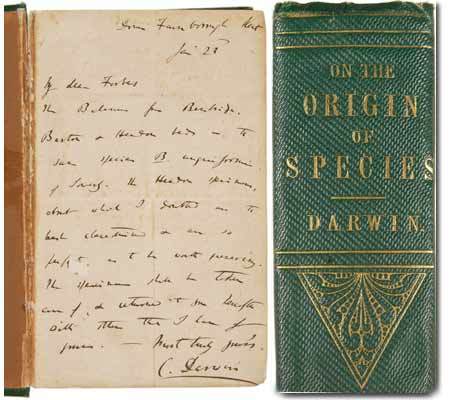
It took another year, during which time Darwin assembled the manuscript of On The Origin Of Species out of the much larger manuscript he had been writing, before the idea truly reached the public and there was a reaction this time. Scientists, on the whole, accepted the idea. The public was a bit more ambivalent. The church mainly hostile. Predictable perhaps. Darwin's book was a best seller, and a piece of pure scientific research. The reason why science could accept it was because Darwin had done his work.
Here was a novel idea, backed up by superb research, including experimental results, collected from around the world. Darwin also realised that there were gaps that would need to be filled in and that others would do that for him. He wasn't so arrogant as to criticise his critics for their ignorance. He listened and reworked his ideas on that basis. He was wrong on inheritance but right on so much else. The stack of evidence collected in the 150 years since is huge. It is wrong to go against the idea of evolution by natural selection on the basis of science. Those that deny it do so for other reasons.
But Darwin was much more than the evolution man. He could lay claim to founding modern biology. After all, he gave it a unifying theory. He virtually invented psychology, plant physiology, sexual selection and much besides. His works were many and varied and he is usually charicatured by those who have read little beyond a potted biography (like this one). I say virtually back there because I am sure others will lay claim to inventing those fields too. But Darwin did so much, he is rightly lauded as a great scientist.
A few years back there was much excitement in certain quarters at the revelation that scientists were actually arguing about evolution. Books were written about it. It was knock me down with a feather territory. Scientists argue about all sorts of things. It is part of how science makes progress. If everyone agrees in a scientific field, it becomes stultified. What really happens is that scientists examined assumptions, go back and test ideas, try new things, use new techniques to find out whether they got it right or not. One textbook piece of science, the natural selection of the peppered moth, Biston betularia, came under scrutiny. In short, the Industrial Revolution made trees sooty, and this favoured the dark form of the moth rather than the lighter form. Birds would see the light form resting on trees. Those light ones would then get eaten. The original research suggested that dark forms would prevail and so they did. Recent research, in the light of the suggestion that the results of the original research were not, let's say, entirely valid, has shown that, knock me down with a feather, the dark ones will prevail on dark backgrounds because the moths do actually sit on tree trunks at dawn and get eaten by the birds if they can be spotted. One up for Darwin.
My post yesterday on ignorance is balanced by this one. I thought of calling it knowledge but it is subtly different to just knowing stuff. It is about being right, for the right reasons and with the right evidence to back it up. Science can encompass speculation, and does, if it has a basis in fact and if it is interesting or testable. Science does not encompass those speculations that rely on chucking out so much valid, tested and reliable evidence that it is like starting again.
I've been busy for the last few weeks but now I can come back to the keyboard, a couple of things that have drifted across my consciousness in that time can now occupy my time a little bit. They both add up to what I think can only be called ignorance.
I am not proud of my ignorance but on most subjects I am ignorant. I know little about many things. I couldn't tell you much about the mineral wealth of Finland, for instance, or name the team members of the 1947 FA Cup Winners. This is the sort of incidental ignorance that comes from not needing or wishing to know those things. If I did want to know them, I am sure I could find them out. After all, I am writing this to add to the general sum of things that make up the Internet which is where I would research what I needed to know. I don't distrust the Internet's ability to give me the truth, but I do check to see if unrelated sites will give me supportive information or not.
Charlton Athletic, winners of the 1947 FA Cup (courtesy of charltonlife.com)
Anyway, to the first of the signs of ignorance that lies beyond me. It is an accidental ignorance masquerading as knowledge. It is Rupert Sheldrake's latest volume, The Science Delusion. It is the latest of two lines, one running through Sheldrake's work and one running through a line of previous authors. It is the attack on "materialism", the idea that the Universe runs according to naturalistic rules, that nothing is actually predetermined and that matter doesn't really want to do anything. Matter follows the laws of nature. Simple. Sheldrake wishes to assign a form of consciousness to matter and not just to living things. It is hard enough to know where consciousness ends amongst the animal kingdom. I don't know how, for instance, you can detect consciousness in, for instance, an argon atom.
I am sure that Sheldrake and all the others who get hot under the collar that science doesn't admit that there are mysteries which we cannot understand and therefore there must be something else, are totally genuine and honest in their beliefs. I am also totally certain that they are wrong. Not that there might be something else that we don't understand, etc, but that they are wrong on this idea of materialism.
If any subject of academic life is willing to be open to the fact that there might be something else it is surely science. To have been alive between 1890 and 1920 and following closely the discoveries of physics must have been like being in those swirly cross fades between scenes in certain tacky sixties TV shows. After all, much of what we now take for granted was unknown before 1890 and pretty certain by 1920: radio communications, x-rays, radioactivity, quanta, general and special relativity, the Noble Gases, the electron and proton, the atomic nucleus, radium and europium amongst other elements. Keeping up with all that must have been a dizzying experience. And biology was a similar melting pot.
And since 1920, science has continued to put out ideas to be shot down - the Big Bang, multiverses, strings and branes and dark matter and energy. Some are pretty well served by a tranche of evidence and some are pretty speculative, but they are testable. And better than that, they have a whole lot of maths behind them and, as we all well know, the equals sign means just that.
But amongst all this are some spectacular failures - N rays being one that gets trotted out because it is a good sign of what Sheldrake is a purveyor of. Some call it pathological science rather than pseudoscience and this is quite a good term. Pathological science is science that is genuine and honest but just wrong. I feel that Sheldrake's morphogenic fields are this. He believes them, as do some others, but the evidence, no matter how high it stands as a stack of paper, doesn't add up to a convincing argument as far as the majority of scientists are concerned. Scientists are a bit like politicians in one important respect - they try to solve the solvable. There is no point trying to test the untestable, or going back continually to retest something when it has failed to yield worthwhile or even positive results. Mainstream science, a rather boring epithet, does not spend a lot of time on, for example, cold fusion, though some may pursue it.
Read this book
You see, science is not averse to the unusual. If it were then making progress would be slow or non-existent. It is, perhaps, best described as semi-conservative. What works well, what describes reality well, is preserved unless and until something better comes along. That something better may never come along. If you want to know more about these matters, you could easily read the books of Brian Greene, Lisa Randall, Brian Cox and many others.
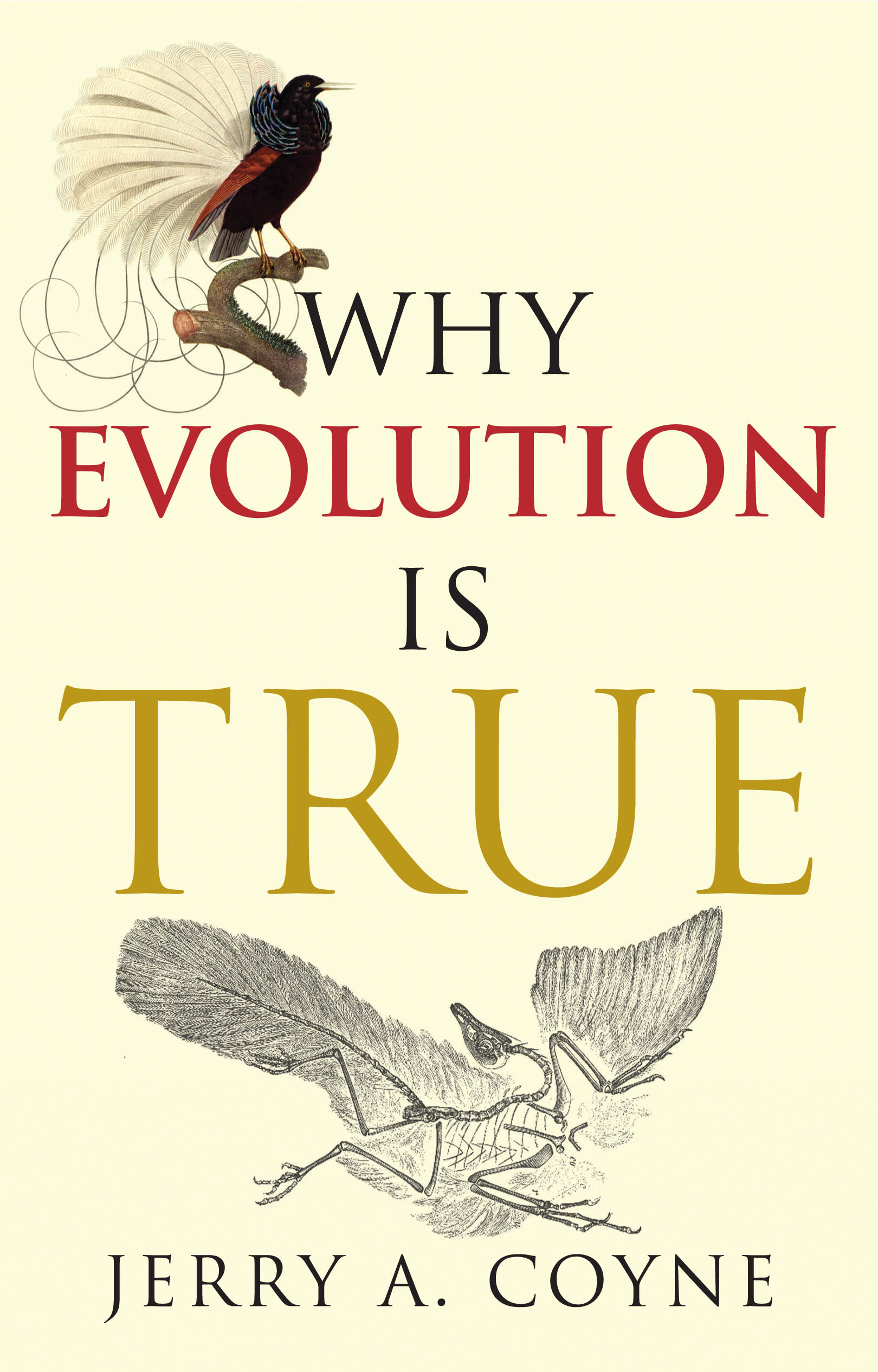
The second piece of ignorance is not the fingers in the ear I'm not listening kind outlined above. It is the confrontational I have heard but I know you're wrong type. Over at Why Evolution Is True is the story of a college newspaper article getting it totally wrong on evolution and the nature of scientific theories (http://whyevolutionistrue.wordpress.com/2012/02/08/only-a-theory/). This was dealt with at essay length by Stephen Jay Gould when Ronald Reagan made a comment about evolution being only a theory. A theory in science should be sufficiently well tested that it would be irrational to deny the theory's truth. But of course scientists are a little vague in their use of theory. String theory may or may not be true but at the moment the evidence is insufficient for mainstream science, although definitely interesting and certainly promising. But perhaps the word theory should not be assigned to it.
One famous theory
Anyway, amongst Biblical creationists, the assertion that evolution is "only a theory" is meant to disparage the vast pile of evidence that supports it, and the logic and maths that goes with it too. Many people don't realise there is plenty of maths associated with evolution but there is. And it isn't hard to find this evidence. But that doesn't stop creationist arguments tending to repeat themselves again and again. Even creationists have got a bit wary of repeating themselves. That doesn't stop them, or stop those who have picked up half of the idea repeating them. I have, myself, had the fun of answering the "if we evolved from apes, why are there still apes" argument.
But to come back to my original point, there is no reason for ignorance in the developed world any longer. There is the Internet and it is dead easy to find information out. If you can't find a web page, or if you want to read the entire text of, say Richard Dawkins latest but don't want to hand over cash, you can go to a library. It's not difficult. But the writer of the article in the college paper is at a college, where they will have a good library, and has started a biology course (as part of her aim to be a teacher, I understand). She has no real reason to be ignorant about what we mean by a scientific theory or what we mean by evolution, and certainly with respect to the evidence for evolution. And it's not as if the evidence is difficult to read - some of the best of modern science writers (Gould, Dawkins, Coyne, Sean B Carroll, Stephen Jones and so on) have put pen to paper to give the general reader the evidence for why evolution is accepted by science. And these writers are so good you can delight in the prose if you don't want to stick too closely to the logic and the science (though, of course, you should).
Read these books
So, to sum up. You can believe what you want but please don't resort to science if your ideas have no basis in evidence. There are plenty of fields of life that don't require science but it is so powerful as a method of finding out what really is that so many fields cloak themselves in science, or at least scientific language. And please don't let your ideas of science get ahead of the evidence. You will be found out very quickly because there are true experts out there. When cold fusion hit the headlines in 1989, and there was a rush to repeat the experiment, but some were already sceptical. The reason - nuclear fusion was well understood and a form of cold fusion known about. What was missing from the modern claim was the expected results that should have happened had nuclear fusion actually transpired.
Read this book as well
Rupert Sheldrake might well be right. Atoms might have consciousness. There might be something else. But "materialism" is so powerful, an idea that provides such wonderful results and gives us such a beautiful and fitting understanding of reality that it is likely to be impossible to dislodge. Furthermore, it enables us to tell the difference between opinion and fact, and that is an important arbiter. Scientists adopt the materialist point of view because it allows science to avoid the trap of being one person's word against another. Without that, what is the point of science?